How a Women's Health Researcher Helped Me Understand Why My Fibroids Kept Coming Back — And What Finally Changed in 90 Days

If you have been living with fibroids — if you know what it feels like to bleed so heavily you are afraid to leave the house, to feel that pressure in your pelvis like something is sitting inside you that should not be there, to be so exhausted for weeks every month that just getting through a normal day feels like a battle — then read every word on this page.
Because I need to tell you something that took me years to find out.
Something that nobody — not your gynaecologist, not the supplement seller on Instagram, not the fibroid diet blog you have been following — has told you clearly.
You have tried things. I know you have.
You changed your diet. You gave up fried food, stopped eating red meat, cut out dairy. You told yourself if you could just eat perfectly, the fibroids would shrink.
They did not.
You bought supplements. Serrapeptase. Black seed oil. Vitex. DIM. You ordered them from three different places and spent money you did not have because someone in a Facebook group said it worked for her.
Some months, you felt a little better. Then you went back for your scan and nothing had changed. Or worse — they had grown.
Maybe you had surgery. A myomectomy. And for a while, you felt hope again. Real hope. You thought: finally, it is over. Then one, two years later, you felt the symptoms creeping back. Your doctor said the word "recurrence" like it was a weather forecast. Like it was just something that happens.
And the worst part of all of this is not the bleeding. It is not even the pain.
It is what it does to the rest of your life.
The way you cancel plans because you never know when a heavy day will hit. The way you stop wearing certain colours, certain clothes. The way your partner looks at you sometimes — not with anger, but with that quiet, patient sadness that somehow hurts more than anger would. The conversations you stop having. The intimacy you stop reaching for because you are simply too tired, too ashamed, too afraid.
The way fibroids have quietly, slowly, become the thing that runs your life — and you are just living around them.
I know. Because I lived there too. For longer than I should have.
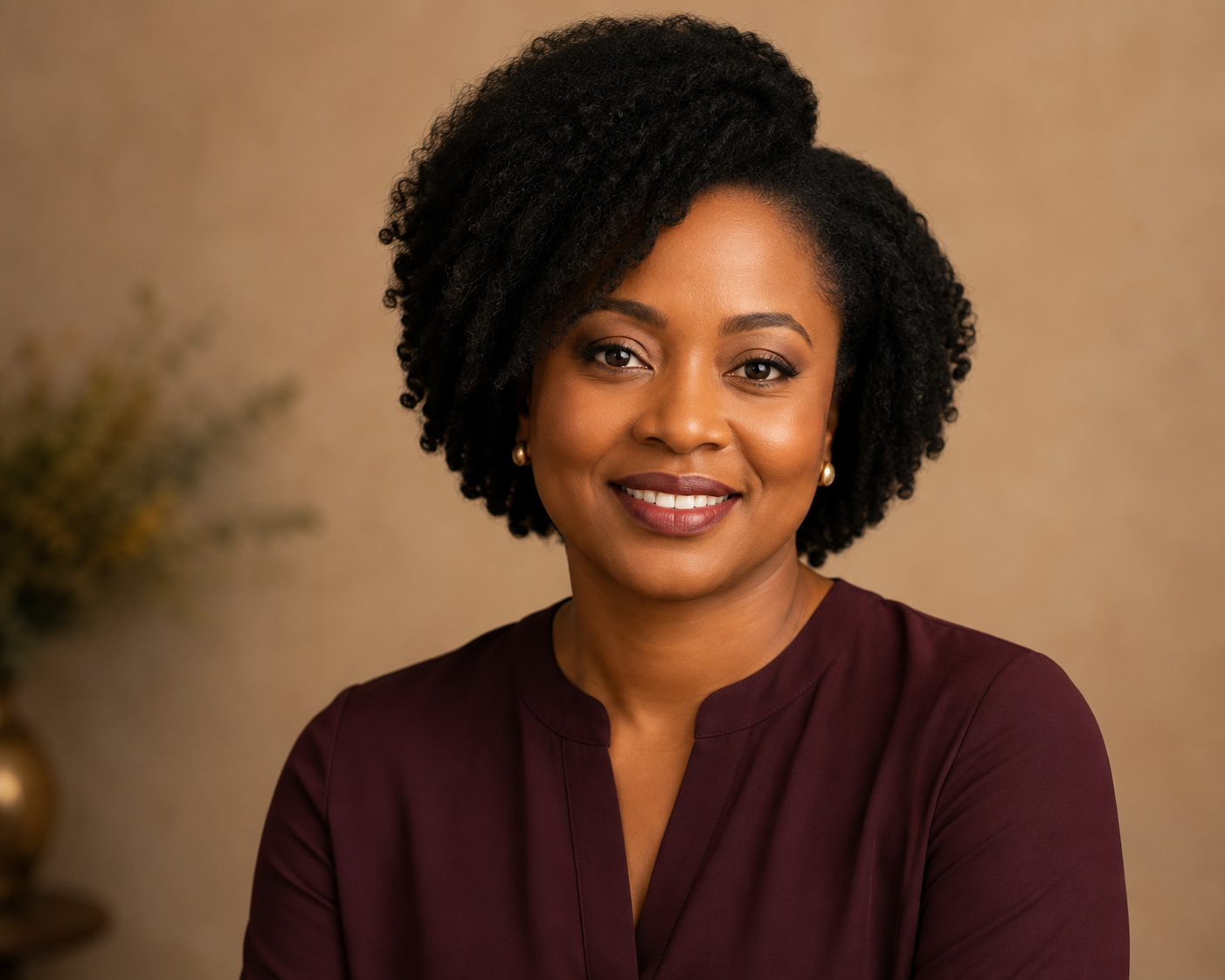
My name is Miriam Asante.
I am just a woman who spent the better part of seven years deep inside this problem.
Not just living with it — but trying to understand it. Reading everything I could find. Reviewing clinical studies, practitioner protocols, hormone research, nutrition data, case histories of women from Nigeria to the UK to the US.
I am originally from Kumasi, but I have lived in Lagos for most of my adult life, and it was here that I first started noticing something that did not make sense to me.
Woman after woman — different ages, different backgrounds, some from Lagos, some from Abuja, some from Port Harcourt, some from the UK diaspora coming back for consultations — all telling almost the same story.
Diagnosed. Tried everything. Still growing. No one could explain why.
I started tracking these patterns obsessively. And the more women I spoke with, the more I reviewed their histories, their diets, their hormone panels, the more I became convinced of something.
The women were not failing their treatments.
The treatments were failing the women.
Not because the advice was wrong, exactly. But because the same advice was being given to women whose fibroids had completely different biological drivers.
One woman had estrogen dominance so severe it would have shown clearly on a hormone test — if anyone had bothered to run one properly. Another had inflammation so deeply embedded in her lifestyle that no supplement was going to touch it without addressing the root. Another had insulin resistance quietly driving everything. Another's body was under such sustained stress that elevated cortisol was disrupting nearly every hormone involved in reproductive health.
Same diagnosis. Completely different bodies. Same generic advice.
That is when everything clicked.
What I am about to share with you did not come from a single dramatic moment. It came from years of frustration and a question that would not leave me alone.
But the moment it truly crystallised — the moment it went from something I suspected to something I was certain of — happened at a women's health gathering I attended in 2024. A small, private gathering of women's health practitioners, traditional medicine elders, and community health educators. The kind of gathering that does not make it onto social media. The kind where real conversations happen.
I had been invited by a colleague who knew how obsessively I had been researching fibroid recurrence. She thought it would be useful. She had no idea how much it would change everything I was doing.
There was an older woman there. A retired medical educator in her seventies who had spent decades working in women's reproductive health across West Africa and had later collaborated with practitioners in the UK. Her name was Dr. Adaeze Ekezie — and she had a reputation among people who knew her for asking the one question that nobody else thought to ask.
She sat quietly through most of the morning session, listening to presentation after presentation about fibroid management. Standard protocols. Surgical options. Hormone therapy.
And then she raised her hand.
"Before we talk about what to do," she said, "has anyone asked which root it is coming from?"
The room went a little quiet.
I do not know why it hit me so hard in that moment. I had been thinking something adjacent to this for years. But hearing it said so plainly — so simply — by someone who had spent five decades watching women fail to recover from interventions that should have worked —
It was like a window opening in a room I had been sitting in for years without air.
I have never written faster in my life than I did in the next two hours.
The Realisation That Changed Everything
After the formal session ended, I found a quiet corner and waited for Dr. Okonkwo. I needed to understand exactly what she meant.
She sat with me for nearly forty minutes.
She did not lecture. She did not use complicated language. She spoke the way someone speaks when they have explained something a thousand times and have finally distilled it to its simplest, most powerful form.
"You cannot treat what you have not identified. And for fibroids, identification does not mean a scan. It means understanding what your body is responding to."
I sat there and felt something release in my chest. Something I had been holding tight for a very long time.
She leaned forward slightly.
Here is what nobody told you:
Your body has a natural hormonal and cellular environment. When that environment becomes imbalanced — through estrogen overload, chronic inflammation, insulin resistance, or sustained stress — your body adapts. It learns the imbalance as its new normal.
And in that adapted environment, fibroids do not just grow. They are sustained. They are nourished. They have everything they need to persist — and to return after surgery, after supplements, after dietary changes — because the ground they grow from has never been addressed.
This is why the same "fibroid diet" works brilliantly for one woman and does almost nothing for another. Because their grounds are different. Their roots are different. And without knowing your specific root — your specific biological driver — you are guessing. Expensive, exhausting, hope-destroying guessing.
I sat with those words for a long time.
Seven years. That is how long I had been watching women struggle with this. Seven years of research, of patterns, of clinical data, of women's stories.
And in forty minutes, this woman had named the exact thing I had been circling around without being able to say clearly.
It took one woman, in a quiet corner of a conference room, to tell me what was actually happening.
The method itself is not complicated. It does not require specialised equipment. It does not require you to travel anywhere, buy expensive ingredients, or follow a punishing protocol that turns your entire life upside down. What it requires is clarity — knowing which of the four root profiles is most likely driving your fibroids, and then following the protocol that addresses that specific root.
Once you know your root, the steps become simple. Specific. Targeted. No more guessing. No more trying everything and hoping something sticks.
The First Weeks: Nothing Looked Different
I will be honest with you about what happened when I began applying what I had learned.
Week one: nothing dramatic. I identified my most likely root profile — estrogen overload with a secondary inflammatory driver. I began the targeted protocol. I kept notes.
Day three, I was already second-guessing myself. This is too simple, I thought. If it were this simple, someone would have told women already.
Day four. Nothing obviously different.
Day five, I noticed something. Not a big thing. A subtle shift in how I felt in the mornings. Less of that low, dragging heaviness I had learned to ignore because it had been there so long I thought it was just who I was.
I told myself not to read too much into it.
Day six. Something else. My energy in the afternoon — which had been consistently absent for years — was present. Quietly, unremarkably present.
Day seven. I stopped expecting nothing and started paying attention.
Week Three: The Shift I Had Stopped Believing Was Possible
By the end of week three, the changes were no longer subtle.
The pelvic heaviness that I had carried for so long I had stopped mentioning it to doctors — it was lighter. Not gone. But measurably, undeniably lighter.
By week six, when my cycle came, something was different enough that I called a friend at 7am. I did not even say hello. I said: "It is different."
She knew exactly what I meant.
By the end of ninety days, I went back for a scan.
I am not going to tell you the fibroids vanished. I am not going to tell you it was a miracle. What I will tell you is what the consultant said when he looked at the images and then at my file, and then at me: "What have you been doing differently?"
The thing that still gets me is not the scan result. It is the morning I realised I had forgotten to check. For years, every single morning, the first thing my body reminded me of was the fibroids. And one morning — I cannot tell you exactly which one — I woke up, made tea, sat at my desk, and it was only mid-morning that I realised: I had not thought about it once. For a woman who had woken up thinking about fibroids every day for seven years, that forgetting was the real result.
But the real test was still ahead of me.
The Conversation I Had Not Been Able to Have
My husband is a patient man. I want to say that first. He never made me feel like the fibroids were my fault. He never made me feel like less of a wife. But patience has its own weight. You feel it even when nobody is pressing it on you.
We had grown careful with each other. Careful in that particular way that couples grow careful when one of them is carrying something chronic and invisible. Everything fine on the surface. Everything slightly held-back underneath.
One evening — a Friday — he reached for my hand the way he used to reach for it early in our marriage. Not asking anything. Just reaching.
And I did not move away.
I want you to understand what that means for a woman who has spent years managing distance. Not because she does not love her husband. But because her body has become a source of so much unpredictability, so much shame, so much quiet sorry-ing, that physical closeness has started to feel like standing at the edge of something she might fall from.
I did not move away.
And later that night, lying there, I cried. Not from sadness. From relief. The particular relief of coming home to something you had been afraid might be gone.
He held me the way he used to hold me when we were newly married — like I had just arrived from somewhere far away. And I suppose I had.
I Did Not Plan to Tell Anyone
What happened with the research was never supposed to become anything public.
But I told one friend. A woman I had known for twelve years, who had been quietly managing her own fibroid diagnosis for nearly as long. I told her what I had learned, what I had mapped out, what the four root profiles were, and how to identify which one applied to her.
She came back to me four weeks later and said: "I need you to write this down."
That one friend told another woman — a sister-in-law in Abuja. That woman sent a voice note to her WhatsApp group. Three women from that group reached out to me directly.
It spread the way things spread when they are genuinely useful. Quietly. Woman to woman. No advertising, no social media campaign. Just women who had been suffering passing along something that was actually helping.
Here is what some of them said.
Same system. Same four roots. Same targeted protocols. Different women, different roots — each finally moving in the right direction for her specific body.
Why I Am Sharing This
After I saw what happened with those first women, I went back to Dr. Ekezie. I told her what had unfolded since our conversation. The women who had identified their roots. The changes they were reporting.
She laughed. Not a surprised laugh. The laugh of someone who has known something for a long time and is watching someone else finally catch up.
"I know," she said. "Because I have seen it before. Many times. But nobody writes it down in a way that women can use themselves."
I asked her permission to document it formally. To create something that any woman could access — not just women who happened to find their way into a room where I was talking.
She agreed. With one instruction.
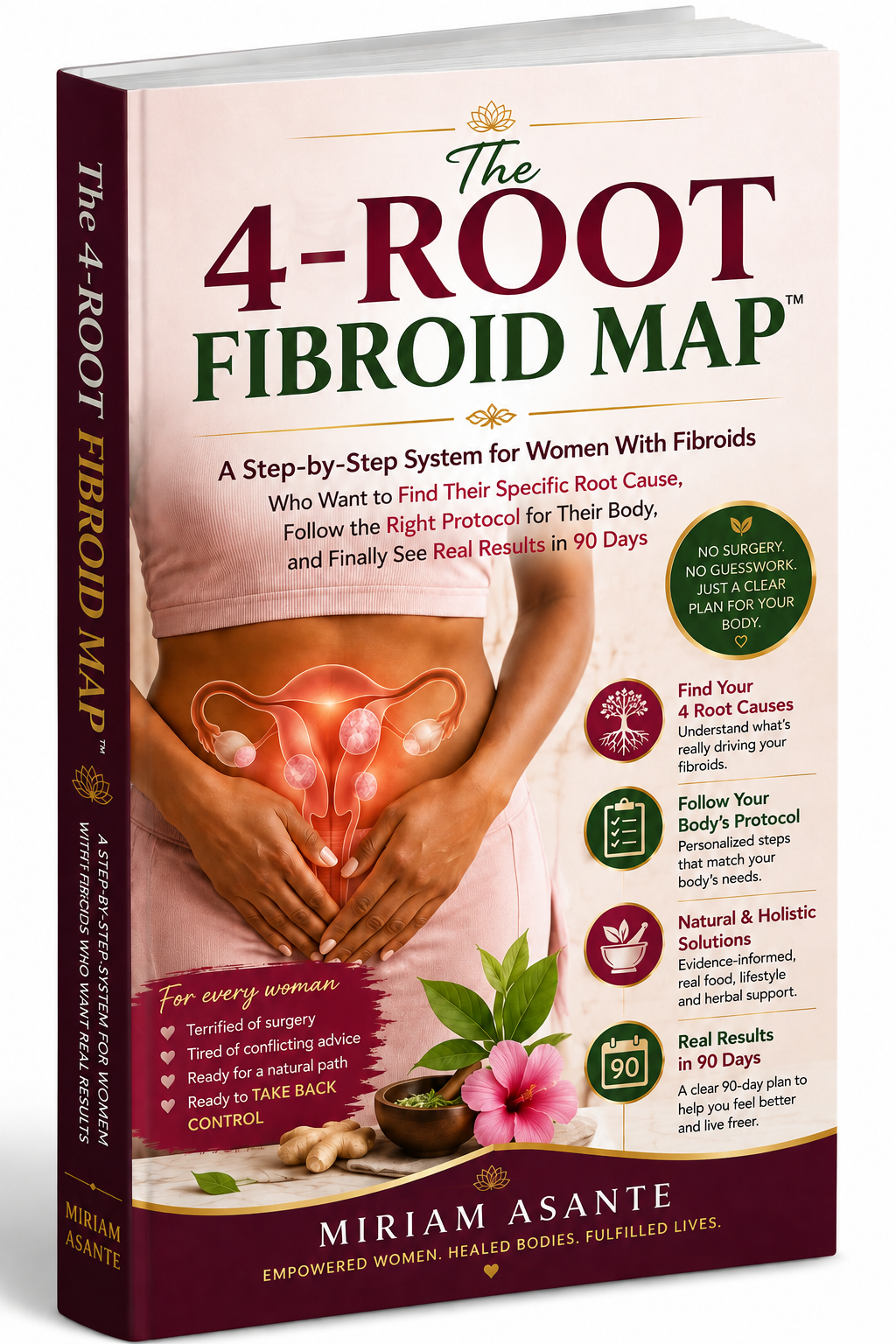
Everything Dr. Okonkwo explained to me — and everything I learned from years of research, pattern analysis, and working with women across Nigeria, the UK, the US, and Canada — is now documented in plain language, step by step, so you can begin the process tonight.
This is not another fibroid diet plan. It is not a supplement list. It is a complete identification and action system — built to help you understand which of the four biological root profiles is most likely driving your fibroids, and then to give you the exact targeted protocol for that root.
- Why Your Fibroids Keep Growing — And What Nobody Has Told You — The real reason generic fibroid advice keeps failing you, what fibroids actually need to survive inside your body, and why the same supplement that changed your friend's life did nothing for yours. (Chapter 1)
- The 20-Question 4-Root Self-Assessment — A step-by-step quiz across four sections that tells you exactly which root — Hormonal, Inflammatory, Circulatory, or Nutritional — is the primary driver of your fibroid environment. Takes 10 minutes. Replaces years of guessing. (Chapter 2)
- The Hormonal Root Protocol — When Oestrogen Is Running the Show — The complete 3-week protocol for women whose fibroids are driven by oestrogen dominance: how to open your oestrogen clearance pathway through the liver, gut, and lymphatic system, the foods silently fuelling your hormonal root (including common Nigerian cooking habits nobody warns you about), and the exact daily actions for each week. (Chapter 3)
- The Inflammatory Root Protocol — When Your Body Is Fighting Itself — The complete 4-week protocol for women whose fibroids are sustained by chronic low-grade inflammation: the surprising gut–fibroid connection, the three hidden inflammatory triggers in Nigerian and diaspora households, and how to cool the fire through food, gut restoration, and stress regulation — week by week. (Chapter 4)
- The Circulatory Root Protocol — When Blood and Energy Stop Moving — The complete 4-week protocol for women whose fibroid environment is driven by pelvic stagnation: what your dark period blood and cold legs have been telling you, the traditional West African pelvic health practices your grandmother knew and why they work, and the specific movement, heat, and herbal practices that shift circulation where it matters most. (Chapter 5)
- The Nutritional Root Protocol — When Your Body Is Running on Empty — The complete protocol for women whose fibroid environment is built on four specific deficiencies — Vitamin D, Magnesium, Iodine, and Iron Balance — including why Black and African women are disproportionately affected, what "normal" blood results miss, the exact foods from your local Nigerian market and diaspora supermarket that close each gap, and how to supplement correctly. (Chapter 6)
- Your Personal 90-Day Fibroid Recovery Roadmap — The complete three-phase framework that sequences everything into Day 1, Phase One, Phase Two, and Phase Three — with your Day 1 checklist so you know exactly what to do tomorrow morning, how to layer a secondary root into your protocol from Week 5, how to track your progress across three months, and how to work alongside your doctor rather than against them. (Chapter 7)
- What to Do After 90 Days — How to assess what changed, how to prepare for your medical review with documented progress, and how to build the practices that became your protocol into a permanent lifestyle — so the environment that fed your fibroids never rebuilds itself. (Conclusion)
You do not need to travel anywhere or see a specialist to begin. Every ingredient referenced is available in your local Nigerian market or a standard UK/US/Canadian supermarket. Total cost of materials for most root protocols? Less than ₦3,000 in Nigeria.
Compare That to What You Have Already Been Spending
The years of your life spent managing, adjusting, apologising, and limiting yourself. The intimacy you have pulled back from. The confidence you have swallowed. The version of yourself that has been waiting, quietly and patiently, for someone to give her the right map.
How Much Does This Guide Cost?
Let me show you what went into building this.
Years of clinical research review and pattern analysis — significant time investment across hundreds of studies and case histories.
Professional medical writing and verification — ₦85,000
Design, layout, and PDF production — ₦35,000
Platform setup, delivery infrastructure, and testing — ₦22,000
Bonus guide research, writing, and design — ₦40,000
Tracker design and formatting — ₦18,000
A fair price for what is inside this guide would be ₦25,000. Possibly more. Women have told me they would have paid that gladly if they had known what was inside before buying.
But I know times are hard. I know what it is to spend money you are not sure you have on something you are not sure will work — because you have done it so many times already. I want this to feel like the easiest decision you have ever made about your health.
So if you take action today —
This price is for the first 200 women who complete payment today.
Once those spots are filled, the price returns to ₦15,000.
Once You Click That Button, Here Is What Happens
- You are taken to a secure payment page. Your payment is processed safely and privately.
- Your payment is confirmed immediately.
- Your complete guide — The 4-Root Fibroid Map™ plus both bonuses — is delivered to your WhatsApp and your email within 60 to 90 seconds. You can begin reading tonight.
It is me, Miriam. As long as your payment is confirmed, your access is 100% guaranteed. You will not be chasing anyone. You will not be waiting days. It arrives in under two minutes.
What Happens In The First 7–14 Days
Real conversations. Real women. Real results.
WAIT — I Have Something Special For You…
If you are one of the first 200 women to secure your copy today, you will also receive both of these bonuses — completely free.
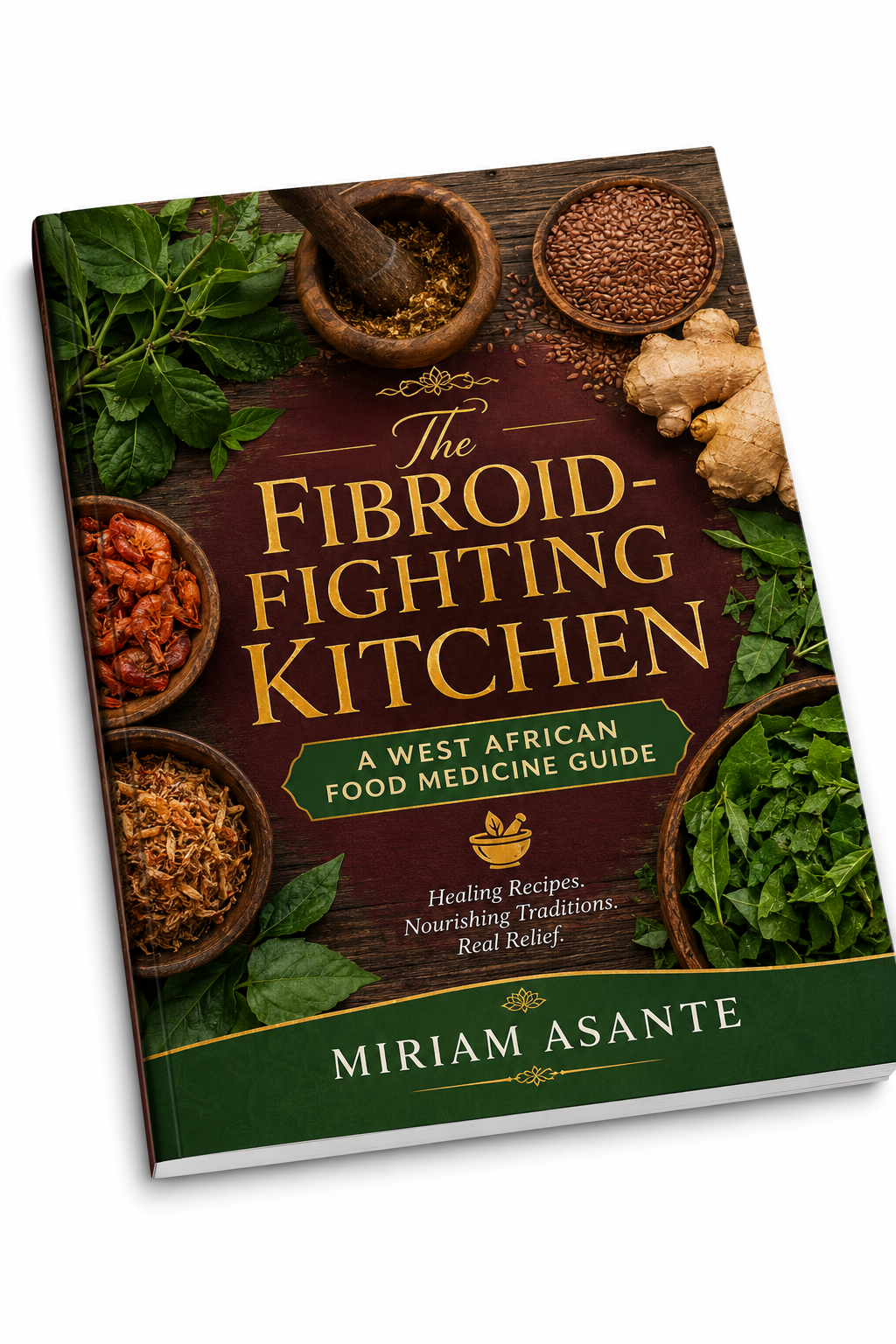
The main guide tells you what to eat and why. This bonus shows you exactly how to use the foods you already have — with specific recipes, preparation methods, and shopping lists built around Nigerian and diaspora kitchens.
Inside: a root-by-root food medicine reference with the top 10 foods for each of the four roots and how to prepare them the Nigerian way. Five simple fibroid-protocol recipes using everyday ingredients — a bitter leaf and flaxseed smoothie, a ginger-clove pepper soup base, an anti-inflammatory egusi variation, a magnesium-rich ugu and sardine stew, and a hormone-supportive pap preparation. Plus a Lagos market and diaspora supermarket shopping guide.
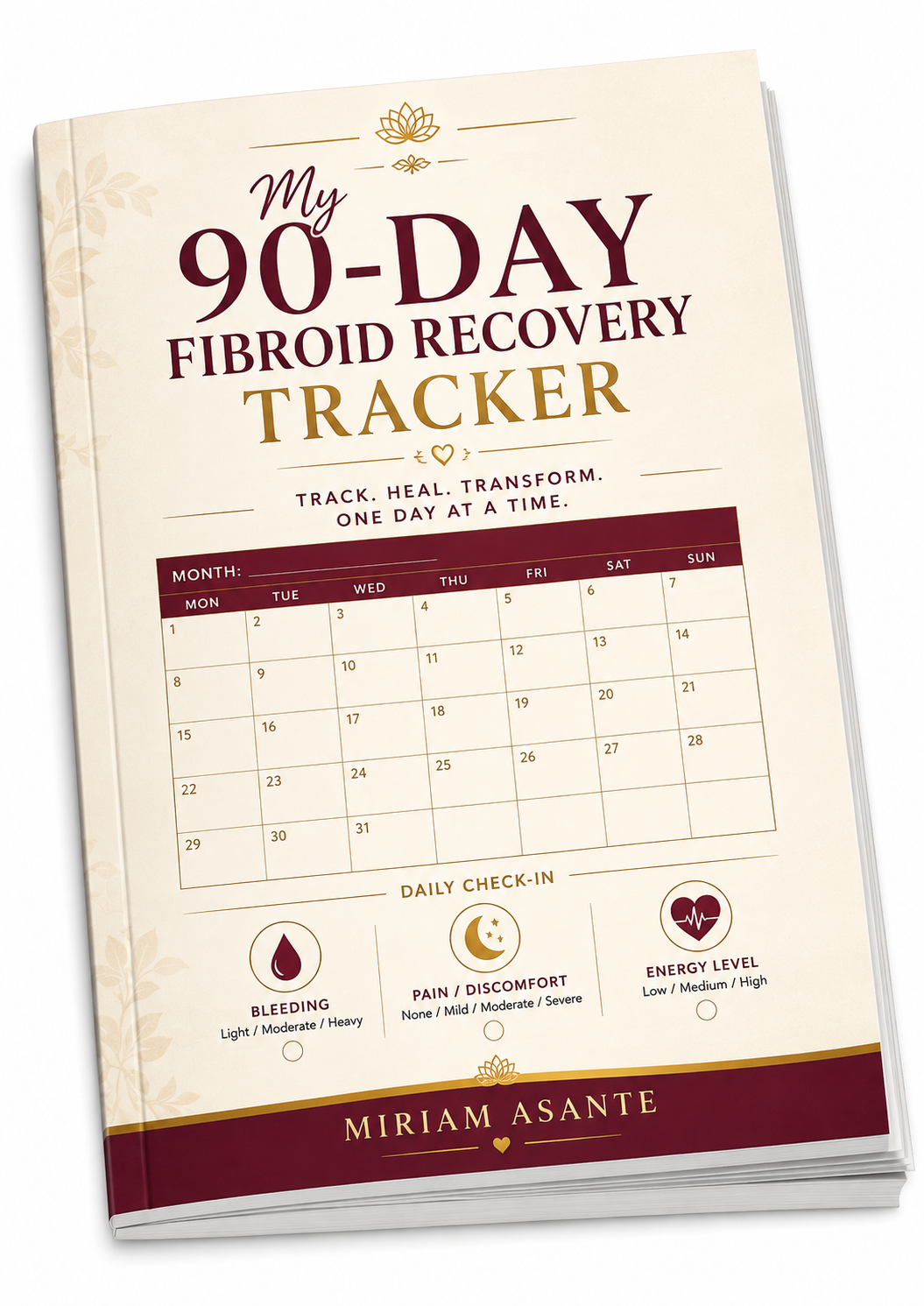
A printable PDF tracker — one sheet per month, three sheets total — built specifically around the six baseline markers from the guide. Women who track their progress see it clearly and stay motivated through the slower middle weeks.
Inside: a monthly symptom scorecard, a daily protocol consistency tracker with checkbox grids, monthly reflection prompts, and a detailed period tracker for the specific markers that show your root protocol is working. Everything you need to bring documented progress to your next medical appointment.
Everything You Are Getting Today
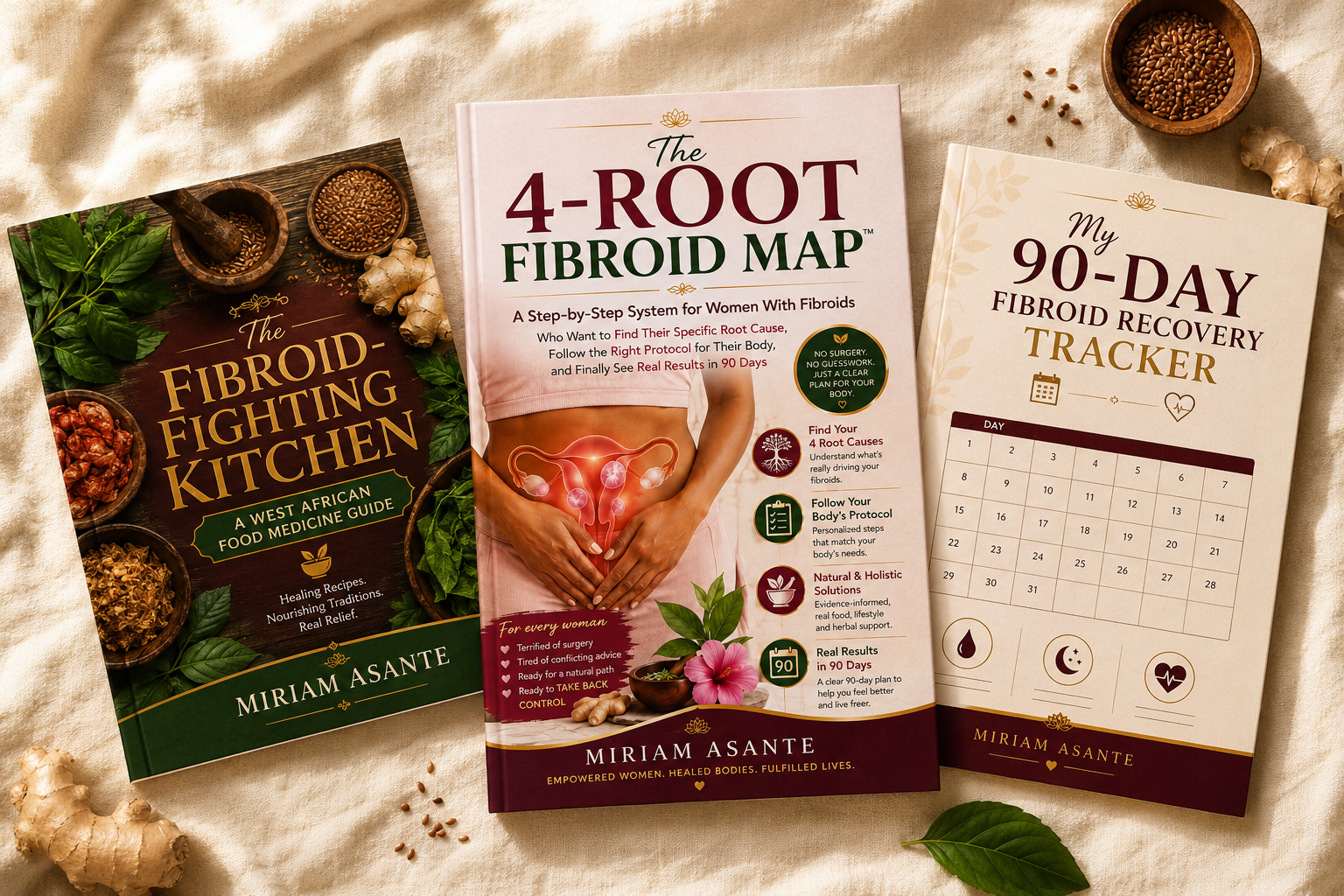
- The 4-Root Fibroid Map™ — Complete 90-day identification and protocol system
₦15,000 - BONUS 1: The Fibroid-Fighting Kitchen: A West African Food Medicine Guide
₦4,000 - BONUS 2: My 90-Day Fibroid Recovery Tracker
₦3,000
Right Now, You Have Two Choices
If you do nothing
- You continue managing symptoms without understanding what is driving them
- The root environment stays unchanged — and fibroids stay with it
- Another cycle comes and goes like every one before it
- The emotional and relational cost continues to accumulate quietly
- You keep spending money on plans built for a different woman's body
If you get the guide today
- You identify your specific root within the first hour of reading
- You follow a protocol designed for your body — not a generic plan
- You finally have a clear picture of what has been happening inside you
- You stop guessing and start addressing the actual driver
- You give your body what it has been asking for all along
One-time payment · Instant delivery to WhatsApp and email
First 200 women only at this price
🛡 30-Day Money-Back Guarantee
Follow the protocol for your identified root for 30 full days. If you have done the daily work, followed the system as written, and you have not seen any meaningful shift — I will refund every naira. No questions. No complicated process. My contact details are inside the guide. You risk nothing.
One Last Thing…
Picture yourself one month from today.
Will you know, clearly and specifically, which biological pattern has been driving your fibroids — not as a guess, but as an identified, mapped reality?
Will you be following a protocol built for your body, your root, your specific terrain — instead of borrowing randomly from advice built for someone else?
Will your next cycle feel measurably different from this one?
Will your husband, your partner, someone who loves you — will they look at you and see something they have not seen in years? Something lighter. Something more present. Something that feels like you coming back to yourself?
Now picture yourself one month from today if you close this page. Everything stays the same. Another month of managing. Another month of not knowing. Another cycle running your life.
The difference between those two versions of you is a decision you make in the next sixty seconds.
I Choose Myself — Give Me My MapIf you have read this far and you are still hesitating —
I need to ask you something gently but directly.
Is it that you do not believe this will work? Or is it that some part of you does not believe you deserve for it to work?
Because I have seen that pattern too. Women who have been managing something painful for so long that relief starts to feel like something other women get. Not them. Not yet.
You have invested hundreds of thousands of naira into consultations, supplements, surgeries — for a body you are still fighting to understand. You have invested years. You have invested your emotional energy, your relational bandwidth, your daily peace of mind.
If you cannot invest ₦5,500 in finally understanding the root of what has been driving this — how do you expect your body to give you something different?
The woman who invests in understanding herself is the woman who heals.
Stop hesitating. Choose yourself.
Yes — I Choose Myself TodayP.S. — The 30-day money-back guarantee means this is entirely risk-free. Follow the protocol for your identified root for 30 days. If you do not see a meaningful shift, you get every naira back. No questions asked.
P.P.S. — This price of ₦5,500 is only available for the first 200 women. Once those spots are taken, the guide returns to its regular price of ₦15,000. I have no way to hold this for you once those spots are gone.
P.P.P.S. — Every day you wait is another day the root environment continues undisturbed. Another cycle running the same way. Another month of managing instead of addressing. The information that changes this is already written. It is waiting for you.
With love for your healing,
Frequently Asked Questions
How will the guide be delivered to me?
Once your payment is confirmed, the guide and both bonuses are delivered directly to your WhatsApp number and your email address within 60 to 90 seconds. You do not need to create an account or log in anywhere. It comes straight to you as downloadable PDF files you can read on your phone or print.
Are the ingredients and foods in the protocol easy to find?
Yes. Every ingredient and food referenced is mapped to two shopping environments: the Nigerian market (Lagos, Abuja, Port Harcourt, Ibadan, and major markets nationwide) and diaspora supermarkets in the UK, US, and Canada. Nothing requires specialised imports or expensive health stores. The estimated material cost for most root protocols is less than ₦3,000 in Nigeria.
What if my fibroids are severe or have been there for many years?
The guide includes a specific section within the 90-Day Roadmap in Chapter 7 for women who have had fibroids for more than five years, have experienced recurrence after surgery, or score high across more than one root. Long-standing fibroids typically indicate multiple overlapping roots, and the layered protocol approach in Chapter 7 addresses exactly this.
My husband is sceptical about natural approaches. What do I tell him?
The guide does not ask you to replace medical care. It works alongside whatever medical approach you are currently following. The four-root framework is grounded in clinical physiology — endocrinology, inflammation science, and metabolic medicine. The tracker in Bonus 2 lets you document your own progress clearly over 90 days, giving you concrete data to share.
How is this different from everything else I have already tried?
Everything else you have tried was built on a one-size-fits-all assumption: that all fibroids have the same driver and therefore the same solution. The 4-Root Fibroid Map™ starts with a completely different question — not "what should every woman with fibroids take" but "which specific biological root is driving this woman's fibroids." Once you know your root, the protocol is targeted, specific, and designed for your biology. That is the difference. Not a different supplement. Not a different diet. A different framework entirely.
Get The 4-Root Fibroid Map™ — ₦5,500 Today
This page is for informational and educational purposes. The 4-Root Fibroid Map™ is not a medical diagnosis tool and does not replace consultation with a qualified healthcare provider. Individual results will vary. The biological framework presented is based on research review and is not a substitute for personalised medical advice.
Comments (847)
Leave a Comment